Month-End for Miners: An Accountant Walks the Fee Ledger at 2,252 TH/s
At 2,252 TH/s the books show about $85.56 of gross mining income per day at $84,692 per coin. The listed 4% on the block-reward component books $3.42 of that as cost, and the listed 2% on PPLNS-distributed parts books $1.71. What follows is a clean month-end close built on those three postings.
Key takeaways
- Gross at 2,252 TH/s is $85.56 daily (0.00101037 BTC), or about $2,566.80 across 30 days.
- The listed 4% component charge is $3.42 a day ($102.67 monthly); the listed 2% charge is $1.71 ($51.34).
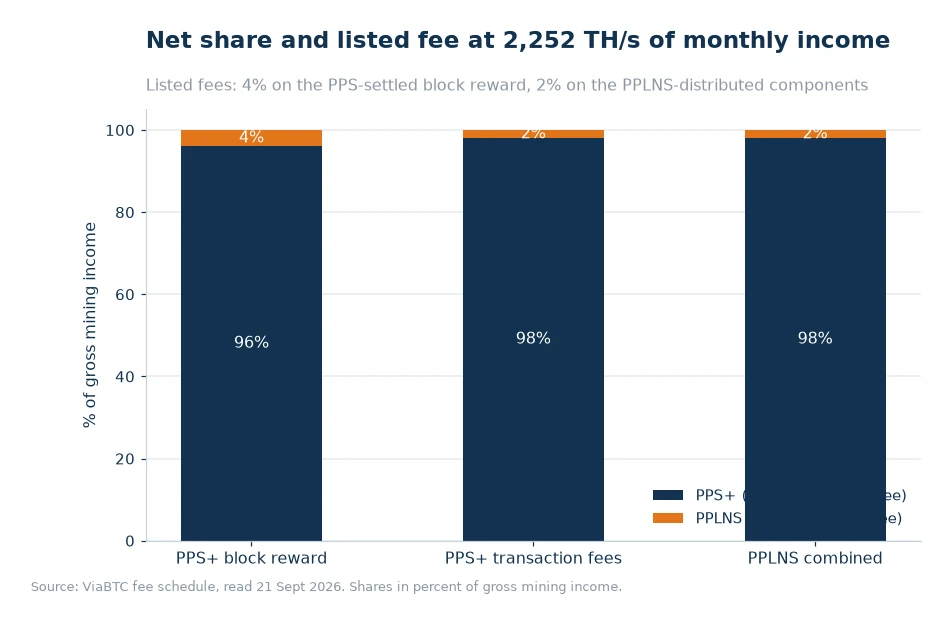
- PPS+ retains 96% of block-reward income; fee and PPLNS lines retain 98% each.
- Withdrawals post at zero fee, so the close needs no exit-cost accrual at all.
Setting up the chart of accounts
Mining income deserves its own ledger structure, separate from any other business the operator runs. Book gross pool income as revenue, each listed component charge as its own cost line, power as utilities, and hosting or rent as facilities. At 2,252 TH/s the revenue line reads 2,252 × 0.00000044865 = 0.00101037 BTC daily, which converts at $84,692 to $85.56 a day and about $2,566.80 per 30-day month. Four lines, no mysteries.
Keep BTC-denominated subledgers alongside dollar books, because price drift otherwise masquerades as operating variance. The coin column measures machine performance; the dollar column measures market luck. Month-end reconciliation compares each column against its own expectation — 0.00101037 BTC daily for the machines, the reference price for the market. Confusing the two is the most common bookkeeping error in mining.
Posting the two fee lines correctly
The classic error books a single six-percent charge, which overstates cost and understates margin in one stroke. Correct practice posts two lines: the listed 4% on the PPS-settled block reward at $3.42 daily ($102.67 monthly), and the listed 2% on PPLNS-distributed components at $1.71 daily ($51.34 monthly). The ViaBTC Pool Fees schedule presents the rates per component, so the journal mirrors the source document exactly.
Auditors love mirrored journals: every cost line traces to a published rate and a verifiable hashrate. Attach the schedule printout, the month's average difficulty, and the 1,003 EH/s network reference to the close file. Next year's accountant — possibly you, possibly a successor — inherits evidence instead of assertions.
Why the block-reward line runs higher
Narrative notes belong in the close file, so record the logic: PPS+ absorbs pool luck and orphan risk into its own balance sheet, crediting every share hourly at current difficulty regardless of blocks found. Warehousing that volatility justifies the listed 4% on the block-reward component specifically. Fee income and PPLNS arrangements leave variance with the miner — payment after 6 confirmations across the last 5 difficulty rounds — hence the lower listed 2%.
That paragraph protects future decisions. When someone proposes switching methods to save a point, the file already explains what the point purchases: predictability for operations with fixed monthly drafts. Treasury choices made with context beat choices made from a rate table alone. Write the why, not just the what.
Accruals that actually belong on the books
Beyond the fee lines, accrue power from meter reads rather than bills, since utility invoices lag consumption by weeks. A 2,252 TH/s fleet near 20 J/TH draws roughly 45 kW, or about $64.80 daily at $0.06 per kWh — the dominant cost line at over $1,944 monthly. Accrue it from the meter and the close stays honest even when the invoice arrives late.
Do not accrue an exit charge: mining payouts withdraw at zero fee, so no provision is needed for moving coins to the treasury wallet. Verify by sampling one sweep per quarter — pre-sweep balance versus received coins — and file the confirmation. Zero is a figure that still deserves evidence. Unprovided costs have a habit of appearing; evidenced zeroes do not.
Reconciling pool credits to the subledger
Tie the pool's credit history to the revenue subledger weekly, not yearly. Expected daily BTC is 0.00101037 at constant difficulty; multiply by elapsed days and compare against posted totals. Small gaps trace to downtime hours — each missing hour at this scale removes about 0.00004210 BTC ($3.57) — while systematic gaps suggest misconfigured workers or stale expectations after a retarget. The coming adjustment near −2.12% is exactly the kind of event that requires refreshing the expectation.
The Profit Calculator rebuilds expectations in seconds whenever difficulty moves, keeping reconciliations current. Pair its output with the multi-currency wallet record under the same login, where hourly credits accumulate across 20+ coins from BTC to KAS. Two sources agreeing means the close rests on rock.
Presenting the month to a non-mining reader
Owners and lenders need one page, not a mempool lecture. Show ceiling ($2,566.80), the two fee lines ($102.67 and $51.34), power accrual, uptime percentage, and net — five rows that any reader grasps. The stacked bars in the chart compress the fee story further: 96% kept on the block-reward bar, 98% on the other two. Executives remember pictures; attach the chart to the summary.
Add a one-line outlook naming the next difficulty estimate and any tariff changes pending. A close that looks backward only is half a document; the outlook line turns it into a management tool. Lenders especially weight forward visibility when the collateral includes volatile coins.
Keeping seven years of closes audit-ready
Retention policy matters the day a tax authority or buyer asks questions. Keep monthly closes, credit-history exports, wallet sweep confirmations and schedule printouts for the full statutory period — seven years in most jurisdictions. Storage is cheap; reconstruction is ruinous. Name files by month and method (PPS+ or PPLNS) so retrieval takes seconds.
The ViaBTC App for iOS and Android helps here unexpectedly: its alert history corroborates downtime entries in old reconciliations. Screenshot major incidents into the month's folder while they are fresh. Future-you, facing an audit across three hardware generations, will be grateful for the paranoia.
| Close entry | Computation | 30-day dollars | Type |
|---|---|---|---|
| Gross mining revenue | 0.00101037 BTC/day at $84,692 | $2,566.80 | revenue |
| Block-reward component charge | listed 4% | $102.67 | cost |
| PPLNS-distributed charge | listed 2% | $51.34 | cost |
| Withdrawal provision | zero fee | $0.00 | none required |
Worked example
Close the books from first principles. Daily BTC per TH/s is 450 ÷ 1,003,000,000 = 0.00000044865, so 2,252 TH/s earns 2,252 × 0.00000044865 = 0.00101037 BTC; at $84,692 that is $85.56 a day and $2,566.80 per 30-day month. The listed 4% on the block-reward component books $85.56 × 0.04 = $3.42 daily ($102.67 monthly); the listed 2% on PPLNS-distributed parts books $85.56 × 0.02 = $1.71 ($51.34 monthly). The withdrawal line books exactly $0.00 — evidenced zero, filed quarterly — completing a close where every figure traces to a published rate or a meter read.
Frequently asked questions
Should the two fee rates be combined into one journal line?
No. Post the listed 4% block-reward charge ($102.67 monthly) and the listed 2% charge ($51.34) separately so each traces to its published component rate.
How is power accrued when the bill arrives late?
Accrue from meter reads: about 45 kW at $0.06 per kWh is $64.80 daily, keeping the close honest regardless of invoice timing.
Is a provision needed for withdrawal costs?
No. Mining payouts exit at zero fee, so the provision is $0.00, verified by sampling one sweep per quarter and filing the confirmation.
Sign the close, schedule next month's review
Approve the five-row summary, lock the subledger, and calendar the next reconciliation for the same date next month. Routine closes compound in value: twelve of them form a performance record that supports loan applications, hardware refresh decisions and, eventually, a sale of the operation itself. Discipline today is valuation tomorrow.
Store the fee schedule printout with the month's file every time, even when the rates have not moved. Unchanged rates evidenced beat remembered rates asserted — the difference only matters on the day someone asks. That day always comes.
Sources: the ViaBTC fee schedule, calculator, wallet and app pages for rates, modelling, custody and monitoring evidence. The close uses chain figures read 21 Sept 2026: 1,003 EH/s of network weight, 132.76 T difficulty, 3.125 BTC per block, 144 blocks a day, BTC $84,692. Published 24 Oct 2026; file the schedule printout with the month.[1].