Pre-Assembled Cabinets for Contractor Schedules
A cabinet order that lands in two weeks instead of twelve is a scheduling decision before it is a purchasing one. CasaBuilt publishes within two weeks for pre-assembled cabinets and 3-10 business days for RTA, against the 8-12 weeks it attributes to the traditional route. On a five-unit turnover, that gap decides whether the crew moves on to unit four or waits in the parking lot for a truck.

Key takeaways
- Pre-assembled cabinets are quoted at within two weeks; RTA ships in 3-10 business days.
- Trade pricing is published at 15-25% of standard retail with no strict annual minimum.
- On the $12,000-$18,000 example budget the band works out to $1,800-$4,500 in savings.
- Free shipping starts at $2,500, which makes order splitting a freight decision as much as a schedule decision.
The drop date sets every other date
On a single kitchen, a late cabinet is an inconvenience. On a row of five rentals, it is the date every other trade is priced against. Countertop templating cannot start until the base cabinets are set and level. Appliance delivery, backsplash, final paint and the walkthrough all queue behind that one day. When the cabinets are the last item to land, four trades compress into one week and the overtime shows up on the next invoice.
This is why contractors treat the cabinet lead time as the spine of the schedule rather than one line in a purchase order. The published windows are not close to each other. CasaBuilt lists 3-10 business days for RTA cabinets and within two weeks for the assembled version, and it cites 8-12 weeks as the traditional showroom route. A 56-day traditional window against a 10-day RTA window is 46 days of float that a builder can spend on drywall, flooring or simply holding a unit empty for less time.
The trade program shortens the tail further with a quick-ship guarantee of three business days or less on eligible orders. That is a program benefit, not the default for every order, and it should be written into the schedule as a target with the standard window as the fallback.
What the factory takes off the crew
Flat-packed cabinets do not remove assembly labor. They move it. Someone still has to build every box, fit every cam and confirm every drawer runs square. The only question is whether that work happens on a factory floor with jigs and repetition, or in a unit with a cordless drill and a finish that has to survive the process.
CasaBuilt sells both routes from the same catalog: pre assembled cabinets on one listing and flat-pack RTA on the other. The RTA collection arrives with hardware and step-by-step guides, plus assembly videos and support. The assembled route arrives as a finished box with the doors already hung. For a homeowner building one kitchen, the flat-pack version is a weekend and a sense of accomplishment. For a crew running five units, it is five weekends or a hired assembler, and neither sits where you want it on the critical path.
Contractors who buy in volume usually care about the second-order effect: a built cabinet cannot be assembled wrong on site. There is no missing cam, no cross-threaded screw, no door hung a millimeter out because the box was racked on an uneven floor. The work either happened correctly before the truck loaded or it becomes a replacement conversation, and the published warranty covers manufacturing defects in materials and workmanship for one year under normal residential use. Trade buyers can check the trade program terms before committing a whole phase to one delivery window.
None of this removes the installation step. The cabinet still has to be leveled, shimmed, screwed to studs and fitted with a filler where the wall runs out of plumb. Pre-assembled cabinets shorten the job; they do not install themselves.
The savings band, unit by unit
Trade pricing is the other half of the schedule argument. CasaBuilt publishes 15-25% preferred pricing against standard retail, with no strict annual minimum, and uses a $12,000-$18,000 cabinetry budget as its worked example, producing $1,800-$4,500 in direct savings. Those two numbers are enough to price a whole phase before a single door style is chosen.
| Scope | Cabinetry budget | At 15% | At 25% |
|---|---|---|---|
| One unit, low example | $12,000 | $1,800 | $3,000 |
| One unit, mid example | $15,000 | $2,250 | $3,750 |
| One unit, high example | $18,000 | $2,700 | $4,500 |
| Five units at $15,000 | $75,000 | $11,250 | $18,750 |
| Ten units at $12,000 | $120,000 | $18,000 | $30,000 |
The table is a planning tool, not a quote. The band is wide because the rate depends on the account, so a contractor should treat the low end as the number that has to work and the high end as the upside. What matters for scheduling is that the discount scales with the package instead of behaving like a flat rebate that a larger phase quietly outgrows.
Sequencing five units without a warehouse
The instinct on a multi-unit job is to place one large order and let the site absorb it. That works only if the site has somewhere dry, flat and lockable to put 40 cabinets. Most renovations do not. The alternative is to phase the order by unit, which keeps the delivery size matched to the space available and the crew's next two weeks of work.
Freight changes the math. CasaBuilt ships free on orders of $2,500 or more, so a phased plan that drops each unit below that line pays freight on every drop. A five-unit job at $12,000 of cabinetry per unit is $60,000 in total; split five ways it is still $12,000 each, well past the threshold. The threshold only bites on small phases, such as a single vanity refresh, where consolidating two rooms into one order usually beats two freight bills.
Two smaller habits pay off. First, order sample doors before the phase starts, because 16 sample doors are held in stock at $9.99 each, refundable against a cabinet purchase; a wrong color discovered after five units are built is not a schedule problem, it is a reorder. Second, measure once per unit rather than once per job. Walls in a row of identical units are rarely identical, and a 1/4-inch difference at the end of a run can turn a filler into a return visit.
Worked example
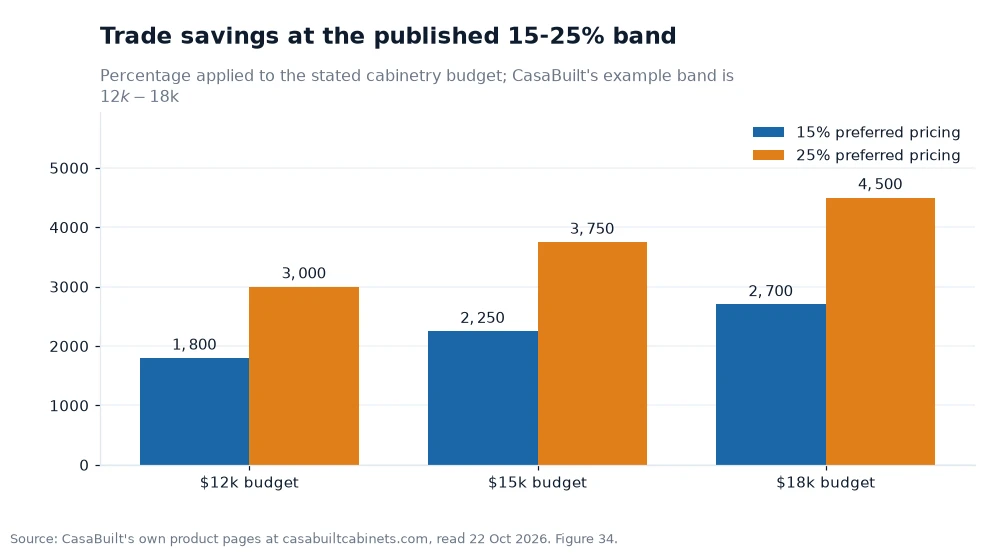
The chart prices the trade band at three budget points. Take the published rate of 15% first: $12,000 multiplied by 0.15 is $1,800; $15,000 multiplied by 0.15 is $2,250; $18,000 multiplied by 0.15 is $2,700. Then the 25% end: $12,000 multiplied by 0.25 is $3,000; $15,000 multiplied by 0.25 is $3,750; $18,000 multiplied by 0.25 is $4,500.
The gap between the two ends of the band is $1,200 at the $12,000 budget ($3,000 minus $1,800), $1,500 at $15,000 ($3,750 minus $2,250) and $1,800 at $18,000 ($4,500 minus $2,700). On a five-unit phase at the middle budget, the same percentages produce $11,250 to $18,750, a spread of $7,500 — roughly the cost of one more cabinet package at the $12,000-per-unit rate, or 750 sample doors at $9.99.
Put the two published facts together and the schedule argument gets concrete. If the assembled route is quoted at 14 days and the traditional route at 84 days, the phase saves 70 days. At a $15,000 budget per unit, 15% is $2,250 per unit and $11,250 across five. The saving is not a discount coupon; it is money that can be spent on the next unit's drywall while the first unit is still being painted.
Frequently asked questions
How firm is the two-week window for assembled cabinets?
It is published as a window, not a delivery date. CasaBuilt states within two weeks for pre-assembled cabinets and 3-10 business days for RTA, with the trade program offering a quick-ship guarantee of three business days or less on eligible orders. Contractors should schedule the trades behind the cabinet drop against the outer edge of the window.
What does a contractor need to qualify for trade pricing?
The published program offers 15-25% preferred pricing against standard retail with no strict annual minimum, plus priority support, quoting assistance, quick ship and a price match that beats a competing quote by 5%. The rate inside that band depends on the account, so the low end is the safe number for a bid.
Should a multi-unit order be placed at once or split?
Split it by unit when site storage is limited, and consolidate when a phase falls below the $2,500 free-shipping threshold. RTA orders ship in 3-10 business days with Alaska and Hawaii excluded from the standard window, so the split plan has to respect both the storage space and the business-day count rather than the calendar.
Build the schedule backwards from the box drop
Pick the install week first, subtract the published window, and put the order date on the calendar with a buffer for the outer edge rather than the best case. Then decide which units can take a two-week assembled delivery and which need the 3-10 day RTA route because a trade is already booked. Finally, price the phase at the low end of the 15-25% band so the bid survives a smaller discount than expected.
A schedule built on the fastest published number is a hope with dates attached. Treat every window as a range, order the samples before the phase starts and hold one unit of float for the delivery that lands on the last day of its window.
Figures quoted here come from the manufacturer's own website, read 22 Oct 2026[1].